On this page
If you have ever stood in an auto parts store staring at a wall of waxes, sealants, and ceramic sprays, you already know the confusion is real. Marketing has blurred the lines between these products so thoroughly that many vehicle owners cannot tell what actually protects their paint and what just makes it shiny for a weekend. This guide explains the real differences between wax and ceramic coating, what each one does well, and how to decide which belongs on your car, boat, or RV.
What wax actually does
Traditional car wax — usually based on carnauba — sits on top of the paint as a sacrificial layer. It fills minor imperfections in the surface, adds warmth and depth to the gloss, and gives water a reason to bead up and roll off. A good wax job genuinely protects the paint, but the keyword is temporarily.
In real-world conditions around Southern Maryland, a quality wax lasts somewhere between four and eight weeks. Sun, rain, washing, and road film all strip it away steadily. By the end of a hot summer month, most of that protection is gone, even if the car still looks decent. Synthetic sealants stretch that to perhaps four to six months, but they follow the same pattern: a layer sitting on the paint, wearing away from day one.
None of this makes wax useless. It is inexpensive, it looks beautiful, and for a show car that gets pampered and rewaxed regularly, it remains a perfectly reasonable choice. The problem is that most owners apply wax once, feel protected, and then drive unprotected for the next year without realizing it.
What ceramic coating does differently
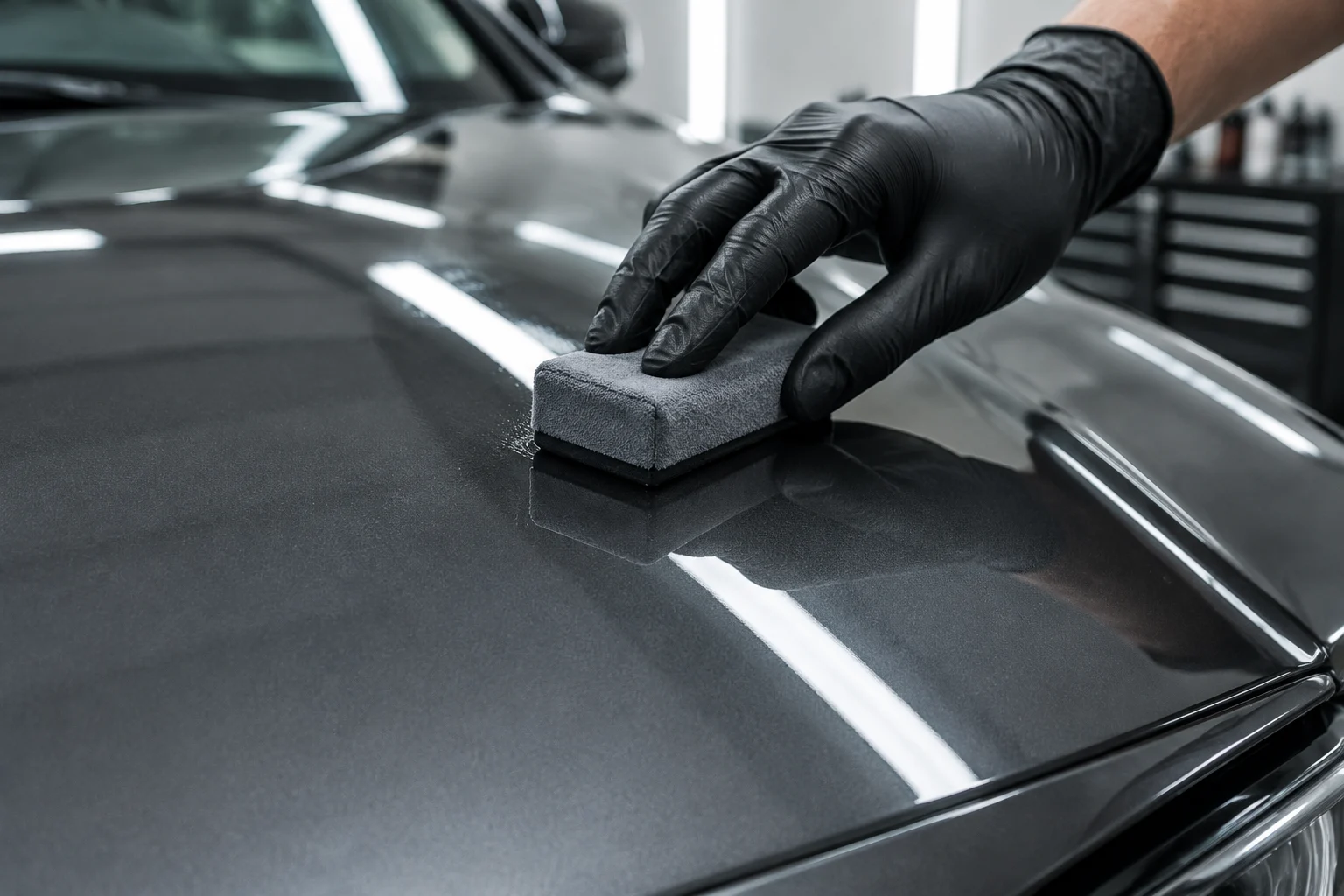
A ceramic coating is not a layer sitting on the paint — it is a liquid polymer that bonds chemically with the clear coat and cures into a hard, glass-like shell. That difference in bonding is the whole story. Because the coating becomes part of the surface rather than a film on top of it, it does not wash away or melt off in the sun. A professionally applied coating protects for years, not weeks.
The practical benefits show up every time the vehicle gets dirty:
- Hydrophobic behavior. Water beads tightly and sheets off, carrying dirt with it. Road film, bug splatter, and bird droppings sit on the coating instead of etching into the paint, and they wash off with a fraction of the effort.
- UV resistance. The coating blocks the ultraviolet exposure that fades and oxidizes paint and gel coat — a serious consideration for vehicles parked outside through Maryland summers.
- Chemical resistance. Bird droppings, tree sap, and bug acids get a barrier between themselves and your clear coat, buying you time to wash them off before they stain.
- Lasting gloss. Because the surface stays smoother, the vehicle keeps that just-detailed depth of shine far longer than wax can deliver.
Our ceramic coating service applies this protection at your location, whether the vehicle is a daily driver, a boat, or a motorhome.
The part nobody tells you: preparation is everything
Here is the uncomfortable truth about ceramic coating: the product is only as good as the preparation underneath it. A coating locks in whatever is on the paint when it is applied. Coat over swirls, water spots, or bonded contamination, and you have sealed those defects under a durable shell.
That is why a professional coating job starts long before the coating bottle opens. The vehicle gets a thorough decontamination wash to remove bonded grime, the paint is inspected panel by panel, and any swirls or light defects are addressed with paint enhancement first. Only then is the coating applied, leveled, and left to cure properly. This process is what separates a coating that performs for years from a driveway spray-on that disappoints in months.
It is also why honest detailers talk about preparation before price. Two vehicles of the same model can need very different amounts of preparation, and the preparation — not the coating itself — is most of the labor.
What ceramic coating will not do
Good information includes the limits, and ceramic coating has real ones:
- It is not armor against rock chips. A coating is a thin, hard layer — it resists chemicals and UV, not impacts. If chip protection is the goal, that is a different product category entirely.
- It does not eliminate washing. It makes washing dramatically easier and less frequent, but a coated vehicle still needs cleaning. The difference is that dirt releases instead of bonding.
- It does not fix neglected paint. Coating over oxidized, swirled paint preserves the problem. Correction comes first, coating second.
- It is not permanent. Years of protection is not a lifetime. Coatings eventually wear and benefit from maintenance and eventual reapplication.
Anyone who promises you otherwise is selling something. When Donald inspects a vehicle for coating, these are exactly the expectations he sets before any work is agreed.
Which one belongs on your vehicle?
The decision comes down to how you use the vehicle and how you like to care for it.
Choose wax or sealant if you enjoy detailing the vehicle yourself every month or two, the vehicle is garaged and lightly used, or you simply want an inexpensive gloss boost before an event or a sale. There is nothing wrong with wax — it just demands commitment to reapplication.
Choose ceramic coating if the vehicle lives outside, you want protection measured in years, you would rather wash less often and more easily, or the vehicle is valuable enough that paint preservation matters financially. Daily drivers, boats, and RVs are the strongest candidates, precisely because they face the most sun, water, and road exposure.
Boats deserve a special note. Gel coat oxidizes faster than automotive clear coat, and the marine environment around the Patuxent and the Chesapeake is relentless. A coating on gel coat slows that oxidation dramatically and makes waterline stains and exhaust soot far easier to remove. The same logic applies to the big fiberglass panels on an RV, where sun fade is the enemy. Our marine detailing and RV detailing services both offer coating as an option after the surfaces are properly prepared.
Protecting the protection
Whichever route you choose, the protection only works if the vehicle is maintained. For waxed vehicles, that means gentle washing and honest reapplication on schedule. For coated vehicles, it means washing with appropriate soaps — harsh detergents and automatic brush washes shorten a coating's life — and occasional inspections to confirm the hydrophobic behavior is still strong.
The easiest way to handle that maintenance is to hand it to someone who does it for a living. A monthly detailing package keeps a coated vehicle washed correctly on a standing schedule, so the coating reaches its full lifespan and the vehicle looks right year-round. Many of our coating customers pair the two services for exactly that reason.
What the cost picture really looks like
It is worth doing the arithmetic honestly, because the sticker comparison misleads people. A tin of wax is cheap, but reapplying it properly every six to eight weeks means ten or more applications a year — and if you are paying a professional each time, the annual cost quietly approaches a coating job while delivering a fraction of the protection. A professionally applied ceramic coating costs more on day one, then asks for almost nothing beyond correct washing for years. For a vehicle you plan to keep, the coating usually wins on cost alone by the second or third year, before you count the preserved resale value of paint that never faded or etched. For a vehicle you are about to sell, the calculation flips: a good wax and a thorough detail before the listing photos is money better spent. The right answer is the one matched to how long you will own the vehicle and how it is stored.
The bottom line
Wax is a beautiful, short-term commitment. Ceramic coating is a long-term investment in the paint itself. Neither is wrong — but they are not interchangeable, and choosing well means being honest about how the vehicle is used and how much upkeep you will realistically do.
If you are weighing the decision for your car, boat, or RV, the fastest way to a real answer is an in-person look at the paint. Send photos through the contact form or call (240) 681-5002, and Donald will walk the vehicle with you, tell you honestly what condition the paint is in, and recommend the protection that actually fits — including telling you when a coating is more than the vehicle needs.
Written by